Emotional Intelligence for Kids: A Practical Guide to Raising Confident, Empathetic Children
Every parent, educator, or caregiver has witnessed the moment when a child struggles to name what they are feeling. A tantrum erupts not from defiance but from frustration that cannot be expressed. A child withdraws not from shyness alone but from confusion about the storm inside them. This is where Emotional Intelligence for Kids becomes more than a concept—it becomes a lifeline. The ability to recognize, understand, and manage emotions is one of the most critical skills a child can develop, yet it is often overlooked in traditional learning environments. Emotional Intelligence for Kids offers a structured, playful, and deeply human approach to building this foundation. This article explores what emotional intelligence means for children, how a dedicated resource like the Emotional Intelligence for Kids book can transform daily interactions, and how to evaluate whether such a tool fits your child’s unique needs.
What Is Emotional Intelligence for Kids and Why Does It Matter?
Emotional intelligence refers to the capacity to recognize, understand, and regulate one’s own emotions while also recognizing and responding appropriately to the emotions of others. For children, this skill set lays the groundwork for everything from forming friendships to handling disappointment, from participating in group activities to resolving conflicts peacefully. Emotional Intelligence for Kids reframes this concept into age-appropriate, digestible pieces that children can actually use.
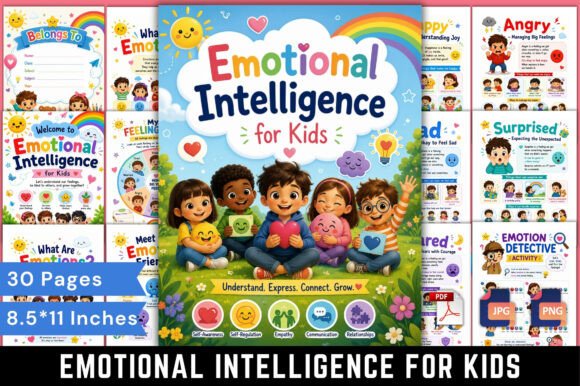
The Emotional Intelligence for Kids book is a beautifully designed educational activity book that teaches children how to understand, express, and manage their feelings in a fun, engaging, and age-appropriate way. Through colorful illustrations, simple explanations, interactive activities, reflection pages, and real-life examples, children learn important emotional and social skills that support healthy relationships, self-confidence, communication, and personal growth. This is more than just a children’s workbook. It is a complete emotional learning journey that helps kids recognize emotions, practice empathy, develop self-awareness, build positive habits, and become confident, caring individuals.
From understanding happiness, sadness, anger, fear, and surprise to learning communication skills, friendship, teamwork, problem-solving, and positive thinking—every page is designed to make emotional learning fun and meaningful. The resource covers self-awareness, self-regulation, empathy, communication, friendship, teamwork, and responsible decision-making in a way that feels like play rather than instruction.
Core Features That Make Emotional Intelligence for Kids Stand Out
Not all emotional learning resources are created equal. The Emotional Intelligence for Kids book distinguishes itself through several key features that align with how children naturally learn.
Social-Emotional Learning Made Simple
The lessons are structured to be easy to understand. Each concept is broken down into small, manageable pieces. A child does not need to master the entire spectrum of emotions at once. Instead, they explore one feeling at a time—what it looks like, what it feels like in the body, and what to do when it arises. This gradual approach builds confidence without overwhelming young learners.
Interactive and Kid-Friendly Design
The book uses bright, colorful illustrations and engaging layouts that invite participation. Children are not passive readers; they are active learners. Activities include drawing their own feelings, matching emotions to scenarios, practicing breathing exercises, and reflecting on their own experiences. This hands-on approach ensures that emotional concepts are not just understood intellectually but are felt and practiced.
Builds a Full Range of Emotional Intelligence Skills
- Self-awareness: Children learn to name their own emotions and recognize physical cues.
- Self-regulation: Simple techniques for calming down, waiting, and making thoughtful choices.
- Empathy: Stories and exercises that help children imagine how others feel.
- Communication: Words and phrases for expressing feelings respectfully.
- Friendship and teamwork: Lessons on sharing, taking turns, and resolving disagreements.
- Problem-solving and positive thinking: Strategies for approaching challenges with a constructive mindset.
Real-Life Examples and Reflection Pages
Each section includes scenarios that children encounter in everyday life—losing a game, waiting for a turn, feeling left out, or being excited about a birthday. Reflection pages invite children to connect the lesson to their own experiences, deepening the learning and making it personally relevant.
Who Can Benefit from Emotional Intelligence for Kids?
This resource is not limited to a single type of learner or setting. Its versatility makes it valuable across a wide range of contexts.
Parents and Caregivers at Home
For families, Emotional Intelligence for Kids becomes a shared activity. Parents can sit with their child, work through the pages together, and use the exercises as conversation starters. The book helps parents understand what their child is feeling and provides a common language for discussing emotions. This strengthens the parent-child bond and creates a home environment where feelings are acknowledged and respected.
Educators and Classroom Teachers
Teachers can integrate the book into morning meetings, social-emotional learning blocks, or guidance lessons. The activities are suitable for individual work, small groups, or whole-class discussions. The book supports curriculum goals related to social-emotional learning, character education, and mental health awareness. It also provides a non-threatening way to address behavioral challenges by focusing on skills rather than punishment.
Counselors, Therapists, and Support Professionals
Mental health professionals working with children find the book useful as a tool for assessment and intervention. The reflective pages and structured activities help children articulate feelings they might otherwise struggle to express. The book can be used in individual sessions, group therapy, or as a take-home resource for families to reinforce therapeutic goals.
Homeschooling Families and Co-ops
For those educating children at home, Emotional Intelligence for Kids fills a critical gap in traditional curricula. It offers a ready-made social-emotional learning program that is easy to implement without requiring specialized training.
Real-World Scenarios and Applications
Understanding how the book works in practice makes its value clearer. Here are a few examples of how Emotional Intelligence for Kids can be used in everyday situations.
Scenario 1: The Morning Meltdown
A child is upset about getting dressed for school. Instead of reacting with frustration, a parent opens the book to the page about anger and frustration. Together, they look at the illustration of the angry face, read the simple explanation, and try the calming breath exercise shown on the page. The child learns to name what they are feeling—“I am frustrated because I wanted to wear my blue shirt”—and practices a strategy to self-regulate. Over time, the child begins to use these tools independently.
Scenario 2: Conflict on the Playground
Two children argue over a swing. A teacher or caregiver uses the friendship and teamwork section to guide a conversation. The children identify their feelings (anger, jealousy, impatience), practice empathy by considering how the other child feels, and brainstorm solutions together. The book provides a structured but gentle framework for resolving the conflict without shame or blame.
Scenario 3: Preparing for a Big Change
A family is moving to a new city or welcoming a new sibling. The child feels anxious and confused. The book’s section on fear and worry offers reassurance and practical coping strategies. The child draws their worry, talks about it with a parent, and practices the positive thinking exercises. The book becomes a comforting companion during a time of transition.
Strengths and Considerations When Evaluating Emotional Intelligence for Kids
No resource is perfect for every situation. Understanding the strengths and limitations helps you decide whether Emotional Intelligence for Kids is the right fit for your needs.
Strengths
- Age-appropriate design: The language, illustrations, and activities are tailored specifically for young children, typically ages 4 to 10. Nothing feels too advanced or too babyish.
- Comprehensive scope: The book covers a wide range of emotions and social skills, making it a complete program rather than a single-topic workbook.
- Easy to use without training: Parents and educators do not need a background in psychology to use the book effectively. Instructions are clear, and activities are self-explanatory.
- Encourages consistency: Because the book is structured as a journey, children and adults can return to it again and again, reinforcing skills over time.
- Fosters connection: The shared experience of working through the book strengthens relationships between children and the adults who guide them.
Considerations and Limitations
- Requires adult involvement: While the book is interactive, it is not a standalone solution. Children benefit most when an adult facilitates, discusses, and models the skills being taught.
- Not a substitute for professional help: For children with significant emotional or behavioral challenges, the book is a supportive tool but should not replace therapy or counseling when needed.
- Varies by child readiness: Some children may be ready for deeper emotional work earlier, while others may need more time. The book is flexible, but adults should adapt the pace to the child’s comfort level.
- Cultural considerations: Emotional expression is influenced by culture. The book takes a general approach that works for many families, but some may wish to supplement with culturally specific examples.
How to Evaluate Whether This Resource Fits Your Needs
Choosing the right emotional learning tool depends on your goals, your child’s personality, and your context. Here are a few questions to guide your decision.
- What are your primary goals? Are you looking to address a specific challenge (e.g., tantrums, shyness) or build general emotional skills? The book works well for both, but knowing your focus helps you prioritize sections.
- What is your child’s learning style? Does your child enjoy drawing, reading, talking, or moving? The book includes a variety of activities, but you may want to supplement with additional hands-on or physical activities if your child is a kinesthetic learner.
- How much time can you dedicate? The book is designed to be used in short sessions, but consistency matters. Even 10 minutes a few times a week can produce meaningful results.
- Are you looking for a one-time resource or an ongoing program? The book offers enough depth to be used over weeks or months, making it suitable for both short-term intervention and long-term development.
- Does the approach align with your values? Read through a few sample pages or the table of contents to see if the tone, examples, and methods resonate with your family or classroom culture.
Practical Tips for Getting the Most Out of Emotional Intelligence for Kids
Once you have the book, a few simple strategies can maximize its impact.
- Create a calm, consistent routine: Set aside a regular time for emotional learning, such as after dinner or before bedtime. A predictable routine signals to the child that this time is important.
- Model emotional intelligence yourself: Children learn by watching. When you name your own feelings aloud (“I am feeling frustrated because I cannot find my keys, so I am going to take a deep breath”), you reinforce the lessons from the book.
- Celebrate progress, not perfection: Emotional skills develop over time. Celebrate small victories—a child who stops to breathe before reacting, or who says “I feel sad” instead of having a meltdown.
- Use the book as a springboard, not a script: Adapt the activities to your child’s interests and experiences. If your child loves dinosaurs, create dinosaur-themed emotional scenarios. The book is a framework, but your creativity makes it come alive.
- Involve other trusted adults: Share the book with grandparents, babysitters, or teachers so that the language and strategies are consistent across different environments.
Final Thoughts on Building Emotional Intelligence in Childhood
Emotional intelligence is not a fixed trait; it is a skill that can be taught, practiced, and strengthened. Emotional Intelligence for Kids provides a gentle, effective, and enjoyable path for children to develop this essential capability. By making emotional learning feel like play, the book removes the intimidation and opens the door to genuine understanding and growth.
Whether you are a parent hoping to raise a resilient child, a teacher building a supportive classroom, or a professional seeking a trusted resource for your work, Emotional Intelligence for Kids offers a practical, people-first approach. It does not promise to eliminate difficult emotions—no resource can do that—but it equips children with the tools to navigate those emotions with confidence and compassion. And that is one of the most valuable gifts we can give the next generation.