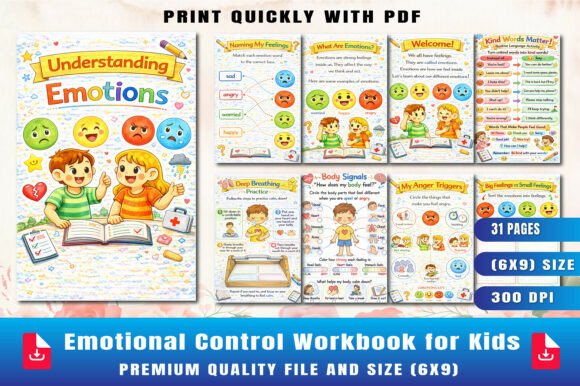
Building Emotional Resilience with the Emotional Control Workbook for Kids
Children experience the full spectrum of human emotion long before they have the vocabulary or cognitive tools to make sense of what they feel. A child who cannot yet name their frustration may scream, hit, or withdraw. Another child who feels overwhelmed by excitement might struggle to settle into a quiet activity. These are not signs of misbehavior—they are signs that emotional regulation is still developing. The Emotional Control Workbook for Kids offers a structured, compassionate path for helping children understand, express, and manage their emotions in healthy ways. Designed for children roughly between the ages of four and ten, this 30-page resource combines clear explanations, guided activities, reflection pages, and calming strategies into a format that feels more like play than instruction.
Why Emotional Control Matters in Early Childhood
Emotional regulation is the ability to recognize what you are feeling, understand why it is happening, and choose a response that aligns with your well-being and social environment. For young children, this is a learned skill—not an innate one. The brain structures responsible for impulse control and emotional reasoning, particularly the prefrontal cortex, are still developing throughout childhood and into adolescence. When a child has a meltdown over a broken crayon or a lost game, they are not being dramatic on purpose; they are demonstrating a temporary gap between feeling and coping.
Research in social-emotional learning consistently shows that children who develop strong emotional regulation skills perform better academically, form healthier peer relationships, and experience lower levels of anxiety and depression later in life. Yet many parents and educators struggle to find resources that teach these skills in a way that children can actually absorb. Abstract conversations about “calming down” rarely land. What works is concrete, repeatable, and visually engaging practice—exactly the kind of practice found in the Emotional Control Workbook for Kids.
Understanding the Emotional Landscape: More Than Happy or Sad
One of the first barriers to emotional control is simply not knowing what you are feeling. Many children have only a handful of emotion words in their working vocabulary: happy, sad, mad, maybe scared. This limited palette makes it nearly impossible to communicate nuanced inner experiences. The workbook addresses this directly by introducing a broader emotional vocabulary through kid-friendly explanations and relatable scenarios.
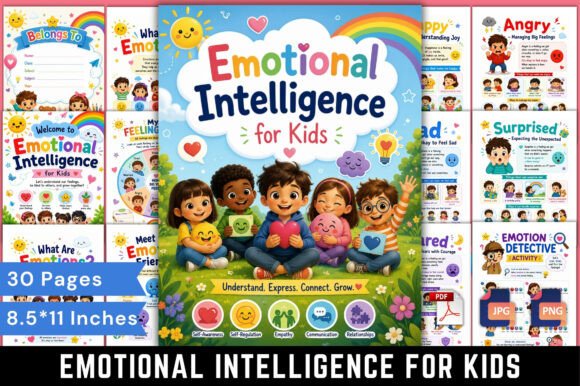
When a child can say “I feel disappointed because my friend couldn’t come over” instead of collapsing into unexplained sadness, they have already taken the first step toward regulation. Naming an emotion creates distance between the child and the feeling, which reduces its overwhelming intensity. The workbook walks children through emotions like frustration, embarrassment, jealousy, worry, and pride, giving each one a name, a face, and a context. This foundation of emotional literacy makes every subsequent strategy more effective.
Identifying Anger Triggers and Recognizing Body Signals
Anger is often the emotion that gets the most attention from adults because it tends to produce disruptive behavior. But anger is almost always a secondary emotion. Beneath it lies hurt, fear, embarrassment, or a sense of injustice. Helping a child identify what actually triggered their anger is more useful than simply telling them to stop being angry.
The Emotional Control Workbook for Kids includes dedicated exercises for identifying anger triggers. A child might discover that they feel angriest when they are tired, when they lose a game, or when they feel left out. Once the trigger is recognized, it becomes predictable, and predictable things feel less overwhelming. The workbook also guides children to notice body signals: tight fists, a racing heart, flushed cheeks, shallow breathing. These physical cues are early warning signs that an emotional wave is building. By learning to read these signals, children can intervene before the wave crashes.
For example, a six-year-old who notices their jaw clenching during a disagreement can take a pause before things escalate. That pause is the moment of choice—the space where emotional control lives. The workbook helps children build awareness of that space through simple reflection prompts and check-in illustrations that feel more like a game than a lesson.
Practical Calming Strategies That Build Self-Regulation
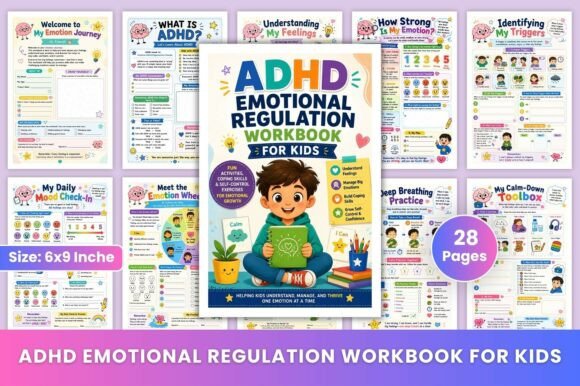
Once a child can identify what they are feeling and notice the physical signs, they need a toolbox of strategies to shift their emotional state. The workbook offers several evidence-based techniques delivered in child-friendly language. Deep breathing exercises are presented with visual cues—perhaps tracing a shape while breathing in and out, or imagining blowing up a balloon. These concrete anchors make abstract instructions like “take a deep breath” actually workable for a young child.
Problem-solving steps are also broken down into simple sequences. Instead of saying “figure out what to do,” the workbook guides children to name the problem, brainstorm two or three solutions, pick one, and try it. This structured approach reduces the paralysis that often accompanies big feelings. When a child knows there is a step-by-step process to follow, they feel more in control and less at the mercy of their emotions.
Positive self-talk practices are woven throughout the pages. Children are prompted to replace thoughts like “I can’t do this” with “I can try a different way” or “I have handled hard things before.” This cognitive reframing is a cornerstone of emotional resilience, and introducing it early through repeated practice in the workbook helps it become an automatic habit over time.
Empathy and Kindness as Pillars of Emotional Growth
Emotional control is not just about managing one’s own feelings—it also involves recognizing and responding to the feelings of others. The workbook includes empathy and kindness activities that encourage children to imagine how someone else might be feeling and to consider actions that could help. These exercises build social awareness and strengthen relationships, which in turn provide a supportive environment for emotional growth.
For instance, a child might be asked to draw a picture of a time they helped a friend who was sad, or to write down what they would say to a classmate who seems lonely. These prompts do more than teach kindness. They help children practice perspective-taking, which is a higher-order emotional skill that supports everything from conflict resolution to collaboration. When children see their own emotional struggles reflected in others, they also develop self-compassion, a quality that research links to lower anxiety and greater emotional stability.
Building Confidence Through Structured Reflection and Tracking
Children gain confidence when they can see their own progress. The workbook includes feelings tracking charts that allow children to log their emotions over days or weeks. This is not about labeling some feelings as good and others as bad. Instead, the tracking charts help children notice patterns: “I feel worried a lot on Sunday nights before school” or “I feel happiest when I play outside.” These observations give children a sense of agency. They begin to understand that emotions are not random storms that descend upon them; they are responses to situations, and situations can sometimes be changed or prepared for.
Confidence-building worksheets encourage children to reflect on moments when they handled a difficult emotion well. Writing or drawing about a time they calmed themselves down or made a good choice reinforces the belief that they are capable. This self-efficacy is one of the strongest predictors of long-term emotional health. A child who believes “I can handle this” is far more likely to attempt regulation strategies than a child who believes “I can’t help the way I feel.”
Using the Workbook Across Different Environments
One of the strengths of the Emotional Control Workbook for Kids is its flexibility across settings. Parents can work through it one-on-one with a child during quiet afternoons or bedtime routines. The 6×9 inch size and large writing spaces make it easy for small hands to use, and the colorful layout keeps attention from wandering. For parents who have been searching for a way to talk about feelings that doesn't feel forced, the workbook provides a natural entry point.
In classrooms, teachers can use the workbook as part of a morning meeting, a calm-down corner, or a structured social-emotional learning block. School counselors and therapists will find the reflection pages and trigger identification exercises useful as homework between sessions, reinforcing the strategies introduced in therapy. Homeschool families can integrate the workbook into their daily rhythm, treating emotional learning with the same importance as reading or math. The Emotional Control Workbook for Kids is also well-suited for use in after-school programs and community groups focused on child development.
The print-ready PDF and high-quality JPG files mean that pages can be printed individually, used digitally on a tablet, or even displayed on a screen during group discussions. This adaptability ensures that the resource fits the user rather than the other way around.
Supporting Self-Regulation as a Lifelong Skill
Emotional control is not about suppressing feelings or pretending everything is fine. It is about developing a relationship with emotions that allows a child to experience them fully without being controlled by them. The Emotional Control Workbook for Kids supports this goal by giving children structured, repeated practice in noticing, naming, understanding, and responding to their emotions. Over time, these practices become internalized. A child who has worked through the breathing exercises and problem-solving steps in the workbook may eventually use those strategies without needing the page in front of them.
The certificate of completion at the end of the workbook provides a tangible sense of accomplishment. It marks a milestone in a journey that will continue for years, but the foundation laid during these 30 pages can change the trajectory of a child's emotional development. Children who learn early that feelings are manageable, that they have choices in how to respond, and that they are not alone in their struggles grow into adolescents and adults who can navigate life's challenges with greater ease.
For parents, teachers, counselors, and anyone who works with children, the Emotional Control Workbook for Kids is more than a resource—it is a bridge between the adult understanding of emotional regulation and a child's lived experience. It meets children where they are, uses language and imagery they can connect with, and patiently builds the skills that will serve them for a lifetime.