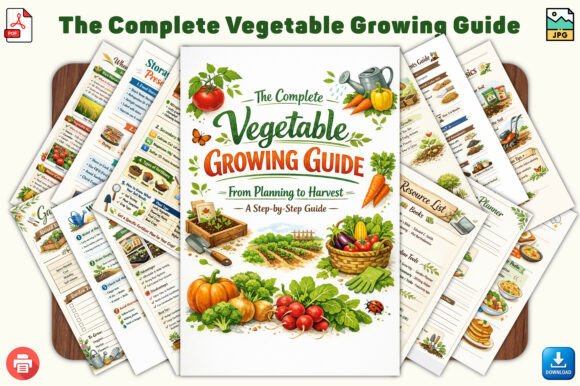
The Complete Vegetable Growing Guide
Starting a vegetable garden can feel like a complex project with many moving parts—soil preparation, seed selection, planting schedules, pest management, and harvesting timing all need to align. Without a clear process, it is easy to get lost in conflicting advice or miss critical steps that affect yield. The Complete Vegetable Growing Guide addresses this directly. It is a 33-page, 6×9-inch PDF and JPG resource designed to function as a structured workflow for anyone growing vegetables, whether in a backyard plot, raised beds, or containers. The guide is not a random collection of tips; it is a sequential, practical companion that fits into the real planning and execution cycle of a home garden.
This article breaks down how this guide works within a gardener’s overall process, where it adds the most value, and how to integrate it smoothly into a seasonal growing routine. Whether you are managing a small urban container setup or a larger backyard vegetable garden, understanding the guide’s structure and applying its principles will save time, reduce mistakes, and improve consistency from seed to harvest.
How the Guide Fits into a Gardener’s Workflow
Gardening is inherently process-oriented. You prepare soil, start seeds, transplant, water, manage pests, and eventually harvest. Each phase depends on the previous one. The Complete Vegetable Growing Guide follows this natural sequence, which makes it useful both as a planning tool before the season begins and as a reference during active growing. Unlike scattered online articles, the guide compresses the essential steps into a compact, linear format that mirrors the actual calendar of a vegetable garden.
The guide’s 33 pages are organized to move from broad preparation (soil, compost, garden layout) into specific actions (seed starting, transplanting, spacing, watering) and then into ongoing care and harvest. This structure allows you to use it in three distinct phases:
- Before planting: Use the soil preparation and composting guidance to amend your beds or containers weeks before sowing. The garden planning pages help you decide what to plant based on space, sunlight, and season.
- During the growing season: Refer to the seed starting instructions, transplanting tips, and watering schedules. The pest control section becomes especially useful when you first notice insects or disease.
- After harvest: The harvesting and storage advice ensures that you pick vegetables at peak ripeness and store them to maximize freshness, reducing waste.
This before-during-after framework makes the guide a reusable asset across multiple growing cycles, not a one-time read. Each season, you can revisit specific sections relevant to that stage.
What the Guide Covers and How It Interacts with Other Resources
The guide is designed to be self-contained for a beginner, but it also complements other gardening tools and practices. It does not replace hands-on experience or local climate data, but it provides the core principles that apply to most vegetable gardens. Here is a breakdown of its main sections and how they interact with external factors:
Soil Preparation and Composting Basics
Soil is the foundation of any garden, and the guide explains how to assess and improve it without overcomplicating the process. It covers the basics of compost types, when to apply amendments, and how to test for drainage. For a gardener integrating this with other resources, the guide’s composting advice works well alongside a local composting guide or a soil test kit. The key is to use the guide to understand the why behind soil prep, then adjust based on your specific soil test results.
Seed Starting and Transplanting Guidance
Starting seeds indoors or direct sowing requires timing and technique. The guide outlines the steps for both methods, including container choice, moisture management, and hardening off. If you are using a seed-starting heating mat or grow lights, the guide’s general timing rules can be adapted to your equipment. The transplanting section covers how to move seedlings without root damage, which is especially useful if you are combining this with a raised bed system that has specific spacing requirements.
Plant Spacing and Watering Tips
Spacing is often where beginners make mistakes, leading to overcrowding or poor airflow. The guide provides clear spacing guidelines for common vegetables. When paired with a garden planning app or a simple grid layout, these numbers help you map out your beds efficiently. The watering advice focuses on deep, infrequent watering rather than daily misting, which is a practical principle that works for both in-ground and container gardens. If you use a drip irrigation system, the guide’s watering tips can inform how you set the timer and emitters.
Pest Control Organic Care Methods
Pest management is an ongoing task. The guide emphasizes organic methods: companion planting, physical barriers, and natural sprays. This section interacts well with a local pest identification guide or an extension service fact sheet. The guide gives you a first line of defense; for persistent problems, you can layer in more specific organic treatments. The key is to use the guide’s preventative approach (healthy soil, proper spacing, crop rotation) to reduce the likelihood of severe outbreaks.
Harvesting and Storage Advice
Knowing when to harvest is crucial for flavor and shelf life. The guide provides signs of readiness for common vegetables, plus storage conditions (temperature, humidity) for each. This section is especially valuable if you are growing multiple crops with staggered harvest dates. You can refer to the guide each time you pick a new vegetable variety, ensuring consistent quality. The storage advice also helps you plan your kitchen use: for example, knowing that tomatoes should not be refrigerated if they are not fully ripe.
Practical Implementation Tips for Integrating the Guide
To get the most from The Complete Vegetable Growing Guide, treat it as an active reference, not a passive read. Here are workflow-based suggestions:
- Print or keep the PDF version accessible – The guide is available in JPG and PDF formats, which means you can print the relevant pages or keep them on a tablet in the garden. Physical copies allow you to make notes directly on the pages about your own planting dates or observations.
- Create a seasonal checklist from the guide – Extract the key actions for each month from the planting and care sections. This turns the guide into a timeline that you can follow week by week. For example, the soil preparation section gives you a checklist for fall amendments, while the seed starting section gives you a spring checklist.
- Use the guide alongside your local frost dates – The guide provides general timing but does not replace frost date data. Look up your first and last average frost dates, then adjust the guide’s seed starting and transplanting windows accordingly. This combination gives you a precise schedule for your location.
- Combine with a garden journal – After each season, record what worked and what did not. The guide’s structure gives you a consistent format for note taking. For instance, note which spacing you used and whether yields improved. Over time, you will build a personalized version of the guide.
- Share sections with family or garden buddies – If you are gardening with others, assign tasks based on the guide’s chapters. One person can handle soil prep, another seed starting. This keeps everyone aligned on the overall process.
Usability and Organization: Why the 6×9 Format Matters
The guide’s physical dimensions (6×9 inches) and 33-page length are intentional. This size is compact enough to fit into a garden apron pocket or a small tote, making it easy to consult while working. The professional layout means you can quickly locate the section you need without flipping through dense paragraphs. The JPG files allow you to insert individual pages into a digital notebook, presentation, or garden planning app. For someone who prefers printing, the PDF scales well to standard paper sizes without losing readability.
This usability factor is critical for workflow integration. A guide that is too large or poorly organized becomes a desk-bound reference rather than a field companion. The concise page count also respects your time: you can read the entire guide in under an hour, but you will return to specific sections repeatedly throughout the season.
Long-Term Use and Consistency
A good gardening guide supports not just one season but the development of consistent practices over years. The Complete Vegetable Growing Guide is built for that purpose. Because it covers the full cycle, you can use it to standardize your methods. For example, if you follow the same soil preparation steps each spring, you build a repeatable baseline that makes it easier to diagnose problems. If you switch from in-ground gardening to raised beds or containers, the guide’s principles (spacing, watering, organic pest control) still apply, with minor adjustments to bed depth or container size.
The guide also encourages quality control at each stage. The harvesting and storage advice, for instance, ensures that you do not lose the fruits of your labor to early picking or poor storage conditions. The pest control section helps you catch issues early, before they spread. In a business or homestead context where vegetable production is part of a larger system (such as a small farm or community garden), the guide’s structured approach helps maintain consistency across different growers or volunteers.
Who Benefits Most from This Integrated Approach
The guide is targeted at beginners and home gardeners, but its process-oriented structure also appeals to productivity-minded users who value clear workflows. For example:
- Urban container gardeners can use the spacing and watering tips to maximize yield on a balcony or patio. The guide’s focus on soil preparation is directly transferable to potting mixes.
- Backyard growers planning a new bed can use the garden planning guidance to decide on layout and crop rotation before investing in materials.
- Educators and bloggers can use the guide as a reference when creating content about vegetable gardening, or recommend it as a baseline resource for their audience.
- Gift buyers looking for a practical, no-fluff resource will find the guide’s compact size and clear instructions easy to give to a new gardener who needs a starting point.
The guide does not assume prior knowledge, but it also does not oversimplify. It respects the reader’s ability to apply principles to their own context. That balance makes it suitable for adults who want to learn efficiently without wading through overly chatty or vague material.
Observations on Implementation Efficiency
One of the biggest time-wasters in gardening is correcting mistakes that could have been avoided with a simple reference. Overwatering, improper spacing, and early harvesting are common issues that reduce yields. The Complete Vegetable Growing Guide addresses these directly, which saves you from trial-and-error setbacks. By having the guide on hand during the critical decision points—when you are planting seeds, thinning seedlings, setting up irrigation, or checking for pests—you avoid guesswork.
The guide’s organic pest control methods also save money and time by reducing the need for purchased chemicals or last-minute interventions. Preventative care, as outlined in the soil and planting sections, is always more efficient than reactive measures. The guide helps you shift from a reactive mindset to a proactive, process-oriented one.
In a broader sense, using this guide consistently builds a mental model of the vegetable growing lifecycle. Over multiple seasons, you internalize the steps and rely less on the physical guide, but you will still refer to it for specific details (e.g., exact spacing for a new crop variety). That is the hallmark of a practical resource: it accelerates learning and then remains useful as a reference.
Final Thoughts on Integrating the Guide into Your Routine
To integrate The Complete Vegetable Growing Guide smoothly into your gardening workflow, start by reading it once from cover to cover to understand the full process. Then, identify which season you are entering and focus on the corresponding sections. Keep the guide accessible—either as a printed booklet or a digital file on your phone or tablet. Use it as a checklist rather than a textbook. Over time, you may annotate it with your own notes, creating a personalized version that reflects your local conditions and preferences.
The guide does not replace local knowledge or hands-on experience, but it provides a reliable framework that saves you from starting from scratch. For anyone looking to grow vegetables with confidence, efficiency, and consistency, this compact guide is a practical foundation that fits naturally into the seasonal rhythm of planning, planting, caring, and harvesting.