Choosing the Right Exam Prep Planner for Your Study Style
When exam season approaches, the difference between feeling prepared and feeling overwhelmed often comes down to how you organize your study time. A structured approach helps you track what you have covered, identify gaps, and maintain momentum without burning out. The Exam Prep Planner is one option among many that aims to simplify this process, but understanding how it fits into the broader landscape of study tools is essential before you commit.
What the Exam Prep Planner Offers
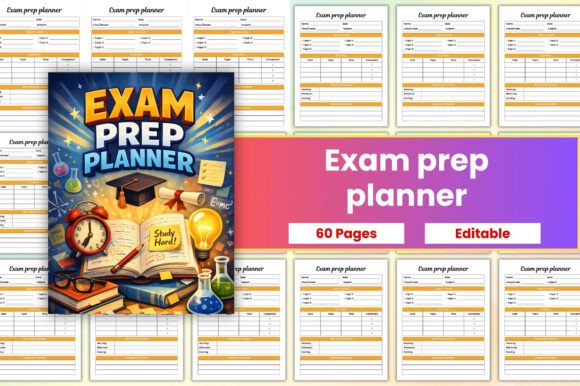
The Exam Prep Planner is designed around a straightforward idea: breaking down large subjects into manageable sessions. Each page typically includes sections for setting session goals, logging daily tasks, marking progress, and leaving room for notes or reminders. This structure encourages you to plan ahead rather than reactively cramming the night before an exam.
What distinguishes this planner from a generic notebook or calendar is the intentional layout. Instead of open-ended pages where you must invent your own system, the guided sections prompt you to define what you want to accomplish in a given study block. For students who appreciate a clear framework without having to design one themselves, this can reduce decision fatigue and help build consistent study habits.
How It Compares with Other Study Planning Approaches
There is no shortage of ways to organize exam preparation. Some students prefer digital tools like calendar apps, project management boards, or specialized study apps. Others rely on bullet journals, simple to-do lists, or printed schedules from their instructors. The Exam Prep Planner sits in a middle ground between freeform analog methods and rigid digital systems.
Digital vs. Analog Planning
Digital tools offer reminders, easy rescheduling, and the ability to sync across devices. However, they also introduce distractions from notifications, social media, or multitasking. The Exam Prep Planner, as a physical product, removes that layer of temptation. Writing by hand also engages memory differently than typing, which may help with retention for some learners. The tradeoff is that you cannot easily search for past entries or adjust schedules without erasing or crossing out.
For students who already spend many hours on screens, an analog planner can provide a welcome break. For those who rely on digital calendars for everything else, a paper planner may feel like an extra step rather than a simplification.
Pre-Designed Layouts vs. Custom Systems
A bullet journal gives you total freedom to design your own study tracker, weekly layout, and progress indicators. This flexibility is appealing if you enjoy creating systems and adapting them as you go. The downside is the time investment—setting up spreads each week can become a procrastination tool in itself. The Exam Prep Planner removes that setup time because the structure is already in place. You fill in the blanks rather than inventing the blanks. For someone who wants to start studying immediately, that immediacy is a real advantage.
On the other hand, if your study style requires tracking very specific metrics—like hours per topic, confidence ratings, or cumulative review cycles—a pre-designed layout may not accommodate all of them without modification. Some users find they outgrow a fixed layout after a few weeks and wish for more flexibility.
Strengths of the Exam Prep Planner
One of the strongest features of this planner is the built-in space for reflection and daily achievements. Many planners focus only on what you plan to do, but the Exam Prep Planner also encourages you to record what you actually accomplished. This feedback loop helps you adjust your pacing and recognize progress, which is motivating during long study periods.
Another strength is the format availability. The Exam Prep Planner is offered as a PDF, JPG, PNG, and through a Canva link. This means you are not locked into a single way of using it. You can print it as a physical planner, import it into a note-taking app on a tablet, or edit it digitally through Canva. That kind of flexibility is less common among printed planners that only come in a bound format. For instance, someone who prefers to use their iPad for note-taking can still use the same layout, just in a digital layer, without losing the structure.
Limitations and Situational Fit
No single resource works perfectly for every student, and the Exam Prep Planner is no exception. If you prefer a minimalist approach and find too many prompts distracting, the structured sections might feel constraining. Some users respond better to a blank page where they can create whatever system matches their current mindset. For those individuals, a simpler notebook or a completely digital calendar might be a better fit.
Another limitation is that the planner assumes you are studying for exams that involve multiple subjects or topics that can be broken into sessions. For students facing a single comprehensive exam, like a professional certification that covers one broad domain, the breakdown might feel artificial. In that case, a planner focused on cumulative review cycles or spaced repetition could be more useful.
Time management is also a factor. If your study sessions are highly irregular—perhaps you have work or family obligations that make it hard to plan a week in advance—then any planner that relies on advance scheduling may feel frustrating. In those situations, a reactive to-do list or a habit tracker might serve you better.
Best-Fit Scenarios for the Exam Prep Planner
The Exam Prep Planner tends to work well for students who:
- Have multiple subjects or topics to cover within a defined period.
- Prefer a clear structure that reduces planning overhead.
- Want to track both planned and completed work for accountability.
- Are comfortable with analog or hybrid (digital-physical) planning.
- Are building study habits for the first time and need guidance.
For example, a university student taking four courses with final exams spread over two weeks would benefit from breaking each subject into weekly sessions, setting daily goals, and marking completion. The planner’s layout directly supports that workflow. Similarly, a professional studying for a licensing exam while working full-time might appreciate the ability to print individual pages and focus on one session at a time without feeling overwhelmed by the whole syllabus.
When Another Approach Might Be Better
If your study process is highly iterative, meaning you revisit topics multiple times in a nonlinear way, a pre-designed planner may not capture that complexity well. In that case, a system based on spaced repetition or a Kanban-style board (whether physical or digital) might give you more freedom to move topics through different stages of mastery.
Another situation where the Exam Prep Planner may fall short is when you need very granular progress tracking—for instance, logging every practice question attempted or tracking time spent per page of notes. The planner’s sections are designed for broader session-level tracking, not micro-level analytics. If that level of detail matters to you, consider supplementing the planner with a separate log or using a spreadsheet alongside it.
Group study scenarios also present a challenge. If you are preparing with peers and need to coordinate shared topics or group reviews, a planner that is personal by design won’t replace a shared timeline or collaborative document. In that case, the Exam Prep Planner could still be used for individual preparation, but you would need a separate tool for group coordination.
Making an Informed Decision
Choosing a study planner is not about finding the one that claims to be the best overall. It is about finding the one that aligns with how you naturally work. The Exam Prep Planner offers a practical, structured format that removes many of the common obstacles to consistent studying, like indecision about what to do next or forgetting to track progress. Its availability across multiple formats increases the chances that you can adapt it to your preferred workflow.
If you have tried studying with only a list of topics and found yourself losing focus or underestimating how long things take, the guided structure of this planner may help. If you already have a system that works and you are simply curious about alternatives, the main benefit would be the time saved in layout design and the built-in progress tracking.
Remember that a planner is a tool, not a solution. Even the best layout will not replace the effort of showing up and doing the work. What a good planner does is make that effort feel more manageable and less scattered. The Exam Prep Planner does that well for a specific set of study habits and preferences. Consider your own study environment, your tolerance for structure, and how much flexibility you need before deciding.
For many students, having a physical or digital page that tells you exactly what to focus on during a study session is worth more than the cost or the time spent learning a new system. If that resonates with your current situation, the Exam Prep Planner is worth trying. If you prefer more freedom or need different tracking capabilities, other approaches may serve you better. The key is to match the tool to the task, not the other way around.