1000 Cognitive Reframing Prompts Canva: Build Clarity and Balance
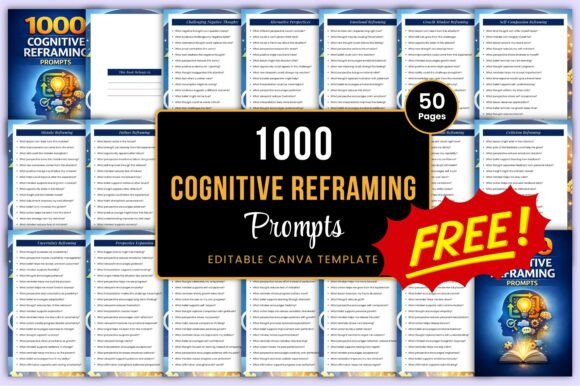
Cognitive reframing is one of the most practical tools for anyone looking to manage their inner dialogue and build emotional resilience. But knowing you should reframe a thought and actually doing it are two different things. That is exactly where 1000 Cognitive Reframing Prompts Canva steps in. It is a collection of one thousand structured prompts designed to guide you through the process of noticing negative patterns, shifting your perspective, and cultivating a more balanced mindset. Each prompt is delivered in an editable Canva format, which means you can customize the look, layout, and language to suit your personal style or professional needs. Whether you are a therapist building a workbook, a creator designing a journal, or someone simply working on your own mental clarity, this resource gives you a ready-to-use foundation that saves time while delivering real depth.
What makes this collection different from generic prompt lists
Most prompt collections offer a handful of questions and leave you to figure out the rest. This set of 1000 cognitive reframing prompts is organized into clear categories: thought awareness, emotional regulation, growth mindset, self-compassion, balanced thinking, positive mindset reset, and deep reflection. That structure matters because it mirrors the actual process of cognitive change. You do not jump straight to optimism when you are in the middle of a spiral. You start with awareness, then move to challenging the thought, then gradually shift toward a more rational and compassionate perspective. The prompts follow that sequence, which makes them useful whether you are working through a stressful week or building a longer-term journaling practice.
The Canva component adds another layer of flexibility. You receive a fully editable template so you can change fonts, colors, and even the wording of the prompts themselves. That means a therapist can brand a workbook for their practice, a blogger can create a freebie for their audience, and an individual can adapt the prompts to feel more personal and relevant. The high-quality print-ready PDF at 6x9 inches also makes it simple to produce physical copies for workshops, clients, or personal use.
Practical applications across different audiences
One of the strongest aspects of this resource is how adaptable it is across different use cases. Below are some of the most realistic ways different people can put it to work.
Therapists, counselors, and coaches
If you work with clients who struggle with anxiety, overthinking, or self-criticism, having a structured set of prompts can accelerate the work you do in sessions. You can assign specific prompts as homework between appointments, use them as conversation starters during sessions, or compile a custom workbook that aligns with your therapeutic approach. Because the prompts are grouped by theme, you can pull from the emotional regulation section for a client dealing with anger, or from the self-compassion section for someone working on harsh inner criticism. The editable format also means you can adjust the language to match your client's reading level or communication style. For example, you might simplify certain prompts for younger clients or add more clinical phrasing for adults in a structured program.
Content creators and journal designers
Journaling is a massive category on platforms like Etsy, Gumroad, and Amazon KDP, and the demand for high-quality, original content is constant. With this collection, you can design and sell your own cognitive reframing journal without spending hundreds of hours writing prompts from scratch. The 1000 prompts give you enough material to create multiple products: a 30-day challenge journal, a weekly reflection workbook, or even a digital card deck. Because the templates are on Canva, you can maintain your own branding and aesthetic. You might choose a minimalist design with neutral colors for a therapy-oriented audience, or go bold with bright typography for a motivation-focused product. The key is that you are not limited to one style—you can experiment until you find what resonates with your audience.
Individuals working on personal growth
For someone who wants to build a regular reflection practice but does not know where to start, this collection removes the friction of coming up with your own questions. You can print a page, open the file, or simply pick one category and work through a few prompts each day. The variety ensures you do not get bored, and the structure helps you notice patterns in your thinking over time. For instance, if you consistently notice that the prompts about self-criticism trigger strong reactions, that is valuable information about where your inner work is most needed. Over weeks and months, you build a habit of questioning automatic thoughts rather than accepting them as facts. That skill alone can reduce anxiety, improve decision-making, and create a more grounded sense of self.
How to use the prompts effectively for lasting change
Having one thousand prompts is impressive, but using them well is what makes the difference. Here are practical recommendations to get the most out of the collection without feeling overwhelmed.
Start with one category at a time. Do not try to work through the entire list in random order. Pick a category that matches your current need. If you are feeling stuck in negative thinking, begin with the cognitive reframing techniques section. If you are recovering from a difficult experience, start with self-compassion and inner healing prompts. Focusing on one area for a week or two gives you time to go deeper rather than skimming the surface.
Write your responses by hand when possible. Research consistently shows that handwriting engages the brain differently than typing. It slows you down, forces you to choose your words carefully, and creates a stronger connection between the thought and the act of writing. The 6x9 inch format of the PDF is designed with this in mind—it fits neatly into a standard notebook or can be used as a standalone journal.
Review your entries after a month. One of the most powerful parts of cognitive reframing is noticing how your thinking evolves. Set a reminder to read through your responses from four weeks earlier. You will likely spot patterns, see how certain thoughts have shifted, and identify areas where you still struggle. That review itself becomes a reframing exercise because you realize that your thoughts are not permanent—they change with practice.
Creative variations and project ideas
Beyond personal use, there are several ways to adapt this collection for different formats and audiences. Here are a few ideas that go beyond the obvious journal or workbook.
Daily prompt cards. Take a subset of the prompts, design them as individual cards in Canva, and print them on cardstock. You can keep a deck on your desk and pull one card each morning. The physical act of drawing a card adds a small ritual to the practice, which can make it feel more intentional. These cards also make thoughtful gifts for friends or family who are interested in personal development.
Digital subscription or email series. If you run a newsletter or a membership site, you can turn these prompts into a weekly or daily email series. Each email delivers one prompt along with a brief explanation of why it matters. Over the course of a year, you have enough content to keep subscribers engaged and coming back. The editable format lets you tailor the tone to match your brand voice, whether that is warm and gentle or direct and practical.
Workshop handouts. If you lead workshops on stress management, emotional intelligence, or resilience, these prompts can serve as structured exercises during the session. You might give each participant a printed page with five prompts related to the workshop theme, then ask them to share their reflections in small groups. The structured format keeps the conversation focused and productive, even with groups that are new to the topic.
Themed journals for specific audiences. Because the prompts are organized by category, you can easily create niche journals. For example, a journal for new mothers might focus on self-compassion and emotional regulation. A journal for entrepreneurs might emphasize growth mindset and balanced thinking. A journal for students could highlight thought awareness and stress management. Each of these products can be created quickly by selecting the relevant prompts and designing a cover that speaks directly to that audience.
What makes this resource trustworthy and effective
From a quality perspective, the collection covers the core principles of cognitive behavioral therapy and positive psychology without needing to be clinical or jargon-heavy. The prompts are written in straightforward language that anyone can understand, yet they are precise enough to guide real reflection. That balance is hard to achieve, and it is what makes the resource suitable for both self-guided use and professional settings.
The editable Canva format also adds a layer of reliability. You are not locked into a fixed design or a rigid structure. If a prompt does not quite fit your situation, you can tweak it. If you want to add your own questions, you can insert them. If you need to change the font size for accessibility reasons, that is a simple edit. This flexibility means the resource can grow with you as your needs change, rather than becoming obsolete after a single use.
Finally, the print-ready PDF ensures that even if you are not a designer, you can produce a polished physical product. Whether you are printing a single copy for yourself or fifty copies for a workshop, the layout is consistent and professional. The 6x9 inch size is large enough to write in comfortably but small enough to carry in a bag, which makes it practical for daily use.
Final thoughts on using these prompts for clarity and growth
Cognitive reframing is a skill, and like any skill, it improves with consistent practice. Having one thousand prompts at your disposal removes the excuse of not knowing what to write. It also eliminates the burnout that comes from trying to invent your own questions every day. The structure, variety, and adaptability of this collection make it a genuinely useful tool for anyone who wants to think more clearly, feel more balanced, and grow in a way that feels sustainable rather than forced.
Whether you are a professional integrating it into your work or an individual investing in your own well-being, the key is to start small and stay consistent. Pick one category, answer one prompt today, and see where it leads. That single step is often all it takes to begin shifting the way you relate to your own thoughts.