Making Grammar Memorable: Why the Right Approach to Parts of Speech Activities Matters
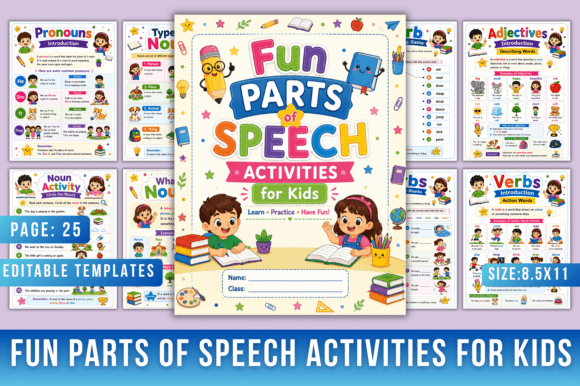
Grammar instruction has a reputation. For generations, it conjured images of dusty workbooks, endless diagramming, and the kind of repetition that made even the most patient child's eyes glaze over. Yet understanding the parts of speech is foundational to literacy. It is the mechanics behind clear writing and confident speaking. The challenge has always been how we deliver this instruction. Kids do not need more drills that feel like punishment. They need something that aligns with how their brains naturally learn: through play, color, and interaction. This is where targeted, creative resources change the game. Fun Parts of Speech Activities for Kids is designed to bridge that gap, turning a traditionally dry subject into something children actually look forward to opening.
Many parents and educators search for materials that balance pedagogy with engagement. They worry about rigor, but they also worry about burnout. A child who is bored before page three is not learning effectively. The solution lies in activity-based learning that feels more like a game than a lesson. The following explores how a thoughtfully designed workbook can transform grammar from a chore into a discovery process.
Why Traditional Grammar Instruction Falls Short
Think back to your own schooling. Perhaps you memorized a list of prepositions or recited the definition of an adverb. You likely passed the test. Did you retain it? For most people, isolated memorization does not stick. Children especially need context. They need to see how a word functions in a sentence, not just label it in a vacuum. They also need varied exposure. A single worksheet format, repeated across thirty pages, leads to disengagement. The brain craves novelty. When a child encounters a matching game, then a coloring activity, then a sentence-building exercise, their attention resets. Each format reinforces the concept from a different angle.
Another common frustration is explanation density. Many workbooks cram complex definitions into small paragraphs, assuming children will unpack them. Young learners, however, benefit from simple, clear language paired with visual cues. A pronoun is not just "a word that takes the place of a noun." It becomes a concept illustrated by a character, a color, or a familiar sentence frame. This approach reduces cognitive load and builds confidence.
Fun Parts of Speech Activities for Kids directly addresses these gaps. It offers short, digestible lessons that do not overwhelm. The structure allows a child to work independently or with a parent, making it suitable for classroom centers, homeschool mornings, or after-school enrichment.
Breaking Down the Eight Parts of Speech Through Play
The core of any grammar workbook lies in its coverage. This resource tackles all eight essential categories: nouns, pronouns, verbs, adjectives, adverbs, prepositions, conjunctions, and interjections. However, coverage alone is not enough. The magic is in the delivery.
Nouns and Pronouns: The Building Blocks of Language
Every sentence starts with a subject. Children learn to identify people, places, animals, and things through interactive exercises. Instead of simply listing nouns, the workbook uses visual matching and fill-in-the-blank activities that require active participation. From there, pronouns are introduced as helpful substitutes. A child practices replacing "the dog" with "it" and "Maria" with "she." This foundational understanding prevents common errors later in writing, such as unclear antecedents or repetitive sentence structures.
Verbs: Capturing Action and Energy
Verbs are the engine of a sentence. Kids naturally love action words—run, jump, shout, build. The workbook channels this enthusiasm through games and sentence exercises. Children do not just identify verbs; they act them out in their minds and on the page. This kinesthetic element, even in a book format, reinforces memory. When a child circles "swim" in a sentence about a pool, they are linking the word to a mental image of movement.
Adjectives and Adverbs: Adding Color and Detail
Descriptive language is where writing comes alive. Adjectives describe nouns, and the workbook explores comparisons and sensory words. Children match adjectives to pictures, sort words by category, and create their own describing phrases. Adverbs follow naturally, explaining how actions happen. A sentence like "The boy ran quickly" becomes a puzzle to solve. By practicing with words like "gently," "loudly," and "soon," kids understand that adverbs modify verbs and add precision. The activities here often involve coloring and drawing, which appeal to visual and creative learners.
Prepositions: Understanding Location and Direction
Prepositions can be tricky for young learners because they often convey abstract relationships. The workbook uses drawing and matching activities to ground these concepts. A child might draw a ball "under" a table or "beside" a chair. This spatial engagement makes location words tangible. By the time they encounter "through," "across," or "during" in reading, they already have a mental framework.
Conjunctions and Interjections: Joining and Expressing
Conjunctions like "and," "but," and "or" teach children how to form compound sentences. This is a leap in cognitive complexity. The workbook breaks this down with simple joining exercises. Interjections, by contrast, are pure fun. "Wow!" "Oops!" "Yay!" Kids love them. This section provides an emotional release within the learning process, reminding children that grammar includes the expressive parts of language, too.
Interactive Practice: More Than Just Busywork
A common criticism of some workbooks is that they ask children to fill in blanks without real engagement. The activities in Fun Parts of Speech Activities for Kids are intentionally varied. Matching games require active decision-making. Circle activities develop visual scanning skills. Sentence practice encourages original thinking. Coloring pages provide a low-stakes entry point for hesitant learners. This variety serves multiple purposes. First, it accommodates different learning styles. A child who struggles with writing may excel at drawing a preposition. Second, it keeps the child guessing. The next page might be a game, not another fill-in. This anticipation is a powerful motivator.
Another practical benefit is the gradual increase in difficulty. Early pages focus on identification. Later pages ask children to apply their knowledge in sentence construction. This scaffolding ensures that concepts are mastered before complexity increases. Parents and teachers can easily identify where a child needs more support because the activities reveal understanding or gaps in real time.
How This Fits Into Modern Learning Environments
The landscape of education has shifted. More families are homeschooling. More classrooms use learning stations. More children need materials that work independently. A workbook like this fits seamlessly into these scenarios. For a homeschool parent, it provides a structured lesson without requiring extensive prep. For a classroom teacher, it works as a center activity or a supplement during grammar units. For a tutor, it offers ready-made intervention material. The book's colorful design and game-like feel mean children often choose it over screens, which is no small feat in today's digital age.
Additionally, the workbook aligns with common core and state standards for elementary grammar. This is reassuring for educators who need to demonstrate progress. The skills covered—identifying nouns, using correct verb tenses, applying adjectives and adverbs, combining sentences—are benchmark skills in the early grades. Using a resource that teaches these skills through play does not sacrifice rigor. It enhances retention.
Practical Tips for Getting the Most Out of the Workbook
To maximize effectiveness, consider how you integrate the activities into your routine. Here are several observations from experienced educators and parents:
- Short sessions work best. Aim for twenty minutes at a time. Stopping before the child is tired keeps motivation high.
- Let the child choose. Allow them to pick which activity to start with. Autonomy increases investment.
- Read aloud together. For emerging readers, the explanations are a perfect opportunity for shared reading. Point to examples and discuss them.
- Celebrate the drawings. The coloring and drawing components are not filler. They allow a child to process grammar visually. Display finished pages to build pride.
- Connect to real books. After a lesson on adjectives, find a descriptive paragraph in a storybook. Ask the child to spot the describing words. This transfer shows the real-world application.
- Review gently. A few days after completing a section, revisit the matching game. Low-stakes review cements long-term memory.
These strategies turn a workbook into an interactive experience. The goal is not to finish the book quickly, but to absorb the concepts deeply. Rushing defeats the purpose. Let the child move at their pace. Some pages may inspire extended coloring. Others may spark conversation. Both outcomes are valuable.
Building Confidence and Lifelong Skills
There is a deeper benefit here that extends beyond grammar itself. When children master the parts of speech, they gain a sense of competence. They can look at a sentence and understand its structure. This analytical skill translates to reading comprehension and writing clarity. A child who identifies adverbs can also recognize how a character in a story acts. A child who uses conjunctions can construct more nuanced arguments. These are not just test-taking skills. They are communication skills that last a lifetime.
The workbook's design also helps reluctant learners. Some children avoid writing because they feel unsure. Breaking grammar down into small, playful pieces reduces that anxiety. When a child successfully completes a matching game or fills in a blank correctly, they experience a small win. These wins accumulate. Over time, the child who once groaned at the mention of grammar may actually seek out the workbook. That shift in attitude is transformative.
In an era of educational overload, finding resources that are both effective and enjoyable is a genuine challenge. Workbooks that lean too heavily on drill risk turning children off to language. Workbooks that are all fluff risk teaching nothing. Fun Parts of Speech Activities for Kids strikes a rare balance. It respects the complexity of grammar while honoring how children actually learn. For parents and educators seeking a practical, engaging, and pedagogically sound resource, it is a choice worth making.
Grammar does not have to be the villain of language arts. With the right activities, it becomes a playground. And in that playground, children build the foundation for a lifetime of articulate expression.