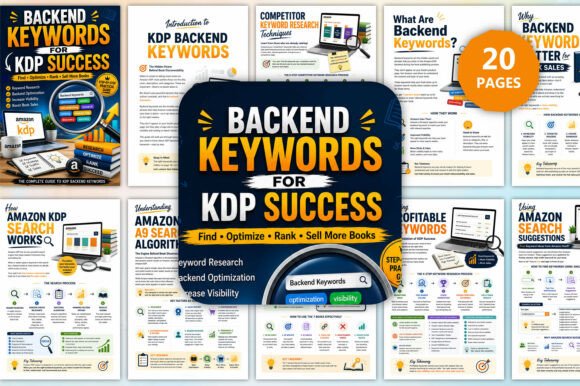
Backend Keywords for KDP Success
Visibility on Amazon is rarely a matter of luck. For independent authors and publishers using Kindle Direct Publishing, the difference between a book that sells steadily and one that languishes often comes down to a single factor: how well the listing communicates with Amazon's search engine. Backend Keywords for KDP Success is not merely a collection of tips — it is a structured system for aligning your book's metadata with how Amazon actually discovers and ranks products. Understanding this system transforms keyword placement from a guessing game into a repeatable part of your publishing workflow.
Why Backend Keywords Matter in the KDP Workflow
Amazon's A9 algorithm considers many signals when deciding where to rank a book: sales history, click-through rates, reviews, and relevance. But before any of those signals matter, the algorithm must first understand what your book is about. Backend keywords are the primary way you tell Amazon this information without cluttering your title or subtitle. They function as hidden metadata that influences search matching without being visible to shoppers.
Incorporating backend keyword optimization into your publishing process means treating it as a pre-launch task with post-launch maintenance. Many authors write their book, create a cover, and then rush through the keyword fields during setup. A more effective approach treats keyword research as a distinct phase — one that happens before you finalize your listing and continues as you monitor performance.
Where Backend Keywords Fit in Your Publishing Timeline
The ideal time to research and implement backend keywords is after your manuscript is complete but before your book goes live. This allows you to test phrases, analyze competitor listings, and refine your strategy without the pressure of a live product underperforming. However, backend keywords are also editable after publication. If you notice a book is not gaining traction, revisiting your backend terms can be part of a mid-cycle optimization push alongside pricing adjustments and promotion scheduling.
For authors managing multiple titles, backend keyword work can be batched. Set aside time each quarter to review keyword performance across your catalog, update terms based on new trends, and refresh listings for seasonal demand. This turns keyword management from a one-time task into a sustainable routine.
Understanding the A9 Algorithm and Keyword Relevance
Amazon's search algorithm does not treat all keywords equally. It prioritizes relevance, meaning that the terms you include must accurately reflect the content and category of your book. Backend Keywords for KDP Success explains how to select terms that match what actual readers type into the search bar, not just broad categories or generic descriptors.
The algorithm also favors co-occurrence — the idea that certain terms naturally appear together in descriptions, reviews, and metadata. By including phrases that mirror natural language, you increase the likelihood that your book will appear for nuanced searches. For example, if you write a guide about watercolor techniques for beginners, your backend keywords might include phrases like "easy watercolor tutorials for adults" rather than just "watercolor book." The former captures specific search intent and faces less competition.
How Backend Keywords Interact with Other Listing Elements
Backend keywords do not work in isolation. They complement your title, subtitle, book description, and category selection. A well-optimized listing uses backend terms to cover search queries that your title cannot accommodate due to length or readability. If your title is short and punchy, backend keywords fill the gap by adding descriptive phrases that help Amazon categorize your book more precisely.
Similarly, backend keywords interact with Amazon's category system. Choosing the right categories narrows your competition and increases the relevance of your backend terms. For instance, if you place a book in a broad category like "Business & Money," your backend keywords need to be highly specific to stand out. If you instead choose a niche subcategory like "Small Business Marketing," your backend terms can reinforce that niche without needing to fight for broad relevance.
Practical Keyword Research Methods for Real Workflows
Effective backend keyword research does not require expensive tools, though tools like Helium 10 and Publisher Rocket can accelerate the process. The core method involves three activities: seed keyword generation, competitor analysis, and search validation.
Seed Keyword Generation
Start by listing every phrase a potential reader might use to find your book. Think about the problem your book solves, the audience it serves, and the format it takes. Write these down in a document without filtering. If you publish a cookbook for keto dieters, your seed list might include "keto meal prep," "low carb dinner recipes," "keto diet for beginners," and "sugar free cooking." Do not worry about competition at this stage. The goal is breadth.
Competitor Analysis
Identify the top 10 to 20 books in your category and examine their titles, subtitles, and descriptions. Look for recurring terms that appear across multiple successful listings. These are signals that Amazon associates with high-performing books in your niche. Additionally, check customer reviews and Q&A sections on competitor pages. Readers often reveal the exact phrases they used to find a book when they ask questions or leave reviews. Terms like "easy to follow," "busy mom," or "beginner friendly" can become valuable backend keywords if they match your content.
Search Validation
Before finalizing your backend keyword list, test each phrase by typing it into the Amazon search bar. Observe the autocomplete suggestions — these are actual search queries used by real customers. Also note the number of results and the titles that appear on the first page. If a term returns mostly irrelevant results or is dominated by huge bestsellers, it may be too broad or too competitive. Long-tail phrases that return fewer results but highly relevant books are often the most efficient for backend use.
Implementing Backend Keywords Correctly
Amazon provides a backend keyword field that allows up to 250 bytes (not characters). This field does not require commas or quotation marks in the traditional sense. Instead, you can enter a continuous string of words, and Amazon will match them in any combination. However, simply dumping every possible term into the field is not optimal.
Best Practices for Structuring Backend Terms
- Group related terms: Separate distinct concepts with spaces but keep phrases that naturally belong together intact. For example, "vegan dessert recipes" works better as a phrase than splitting into individual words that could recombine into irrelevant matches.
- Avoid repeating words from your title: The algorithm already indexes your title and subtitle. Reusing those exact words in backend fields wastes valuable byte space.
- Include synonyms and alternate phrasings: Readers searching for "gluten free baking" may also search "baking without gluten" or "gluten free cookbook." Cover all three if space permits.
- Do not use stop words unnecessarily: Words like "a," "an," "the," "for," and "of" consume bytes without adding unique search value. Omit them unless they are essential to a phrase's meaning.
After entering your backend keywords, wait at least 48 to 72 hours for Amazon to index the changes. During this period, do not make additional edits to the same field. Frequent changes can confuse the index and delay visibility improvements.
Long-Term Maintenance and Iteration
Keyword performance shifts over time. Seasonal trends, new competitor titles, and changes in reader behavior all affect which terms drive traffic. Scheduling a quarterly review of your backend keywords keeps your listing aligned with current demand. During these reviews, compare your current backend terms against newly emerging search data. If a phrase that once performed well now returns stale or unrelated results, replace it with a fresher alternative.
Additionally, after you run a promotion or a price drop, examine your sales analytics. If you notice a spike in sales from a particular referrer or search term within your advertising dashboard, consider adding that term to your backend keywords. This integration between advertising data and organic optimization is a hallmark of a mature KDP workflow.
Common Pitfalls and How to Avoid Them
One frequent mistake is treating the backend keyword field as a place to stuff every possible word without regard for relevance. Amazon's algorithm penalizes listings that use misleading terms because those listings generate clicks but no sales, damaging the book's conversion rate. Only use keywords that honestly describe your book's content and target audience.
Another pitfall is ignoring the byte limit. Non-ASCII characters, such as accented letters or certain punctuation marks, use more than one byte and reduce the number of terms you can include. Stick to standard alphanumeric characters and spaces to maximize your usable space.
Finally, some authors forget to update backend keywords after changing their book's title, subtitle, or category. Whenever you modify any major element of your listing, review your backend terms to ensure consistency. A mismatch between your visible metadata and your hidden keywords can confuse the algorithm and reduce search rank.
Integrating Backend Keywords into a Broader Visibility Strategy
Backend Keywords for KDP Success works best when paired with other optimization activities. Use it alongside competitive keyword analysis for your advertising campaigns, category research for your listing placement, and description formatting to improve conversion rates. The guide's emphasis on long-tail keywords, competitor extraction, and tool recommendations provides a foundation that supports both organic and paid discovery.
For authors who manage a series, backend keyword consistency across books can improve cross-discovery. If each book in a series uses backend terms that reference the series title or common themes, Amazon may surface them together in search results. This compounding effect rewards authors who treat keyword strategy as a system rather than a one-off task.
Practical Workflow Example
- Before writing the listing: Compile a seed keyword list based on your book's core topic and target reader.
- During listing creation: Enter your most specific and relevant long-tail phrases into the backend field, avoiding duplicates from your title.
- After launch: Monitor search term reports from Amazon Ads to identify new phrases that drive conversions.
- Quarterly maintenance: Review and refresh backend keywords based on new competitors, seasonal trends, and ad data.
This cycle turns backend keyword optimization from a passive checkbox into an active part of your publishing operations. Over time, it builds a more resilient listing that can adapt to market shifts without requiring a complete overhaul.
Final Thoughts on Making the System Work
Amazon's marketplace rewards authors who understand that discoverability is an ongoing process, not a launch day artifact. Backend Keywords for KDP Success provides the framework for that process, but the real value comes from consistent execution. By embedding keyword research into your pre-publishing preparation, using competitor insights to refine your terms, and maintaining your keywords as part of a regular review cycle, you create a listing that works with the algorithm rather than against it.
The result is not just better rankings — it is a more efficient path to connecting your book with readers who are actively looking for what you have written. That connection is the ultimate measure of a successful keyword strategy.