My First Activity Book: Early Learning Fun
Early childhood is a window of rapid development, and the materials you choose during these years can shape a child’s relationship with learning for life. My First Activity Book is designed specifically for preschoolers and early learners aged three to six. It blends playful exercises with foundational skill-building, making it a practical resource for parents, educators, and publishers alike. Instead of simply keeping a child busy, this book introduces concepts like pencil control, number formation, shape recognition, and logical thinking through activities that feel like play. Understanding what this book offers—and how to use it creatively—can help you support young learners or even inspire your own educational projects.
What Makes This Activity Book Stand Out
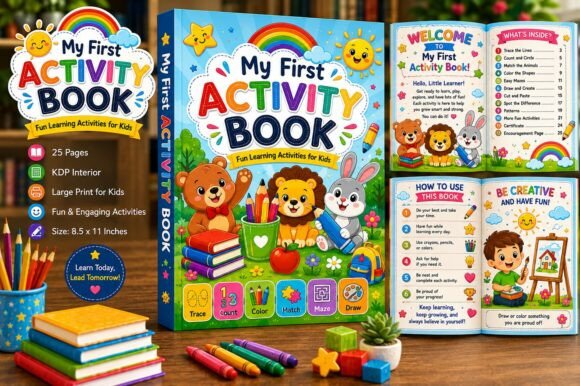
The structure of My First Activity Book is what makes it genuinely useful. With 25 different pages, each measuring a standard 8.5 by 11 inches, the format is clean, accessible, and ready for home or classroom use. The activities are not random fillers; they are sequenced to build confidence step by step. Line and shape tracing improves pencil grip and prepares the hand for writing. Number tracing from one to ten gives children repeated practice forming digits while associating each number with a quantity. Counting and coloring activities reinforce number sense and color vocabulary simultaneously. Matching games, mazes, and spot-the-difference puzzles develop observation, memory, and attention to detail. The variety ensures that no two sessions feel the same, which keeps young learners engaged without overwhelming them.
For anyone responsible for a child’s early learning, this book offers a structured yet flexible tool. You can work through pages in order or pick specific activities based on what a child needs to practice. The inclusion of coloring pages and connect-the-dots exercises adds a creative outlet that balances the more structured tasks. This mix of discipline and freedom is exactly what supports both skill acquisition and a love for learning.
Creative Ways to Use the Book at Home
If you are a parent or guardian, you already know that sitting a child down with a worksheet does not always go smoothly. The key is to turn each page into a shared experience. For example, when working on the biggest and smallest activities, gather real objects from around the house—a large spoon and a small spoon, a big book and a tiny one. Ask the child to compare them before marking the answers on the page. This bridges abstract concepts with tangible reality, making the lesson stick.
Similarly, the animal matching games can become a storytelling prompt. After matching the animals, ask the child what sound each animal makes or where it might live. This extends the activity into language development and imaginative play. The easy mazes can be turned into a finger-walking adventure before using a pencil, which builds motor planning. Even the shadow-finding and spot-the-difference pages can become a friendly competition: “I bet you can find three differences before I finish counting to ten.” Small tweaks like these transform a single page into a multi-layered learning moment.
Adapting for Different Skill Levels
Not every child develops at the same pace, and My First Activity Book accommodates this range naturally. A three-year-old might begin with the coloring pages and simple line tracing, while a five-year-old can move through number tracing and pattern completion with growing independence. If a child finds a particular activity challenging, you can simplify it by focusing on just one row or one section at a time. Alternatively, for advanced learners, you can extend the pattern completion by asking them to create their own patterns using colored pencils or stickers. The book serves as a foundation rather than a rigid curriculum, which gives you room to adapt.
For Educators and Classroom Settings
Teachers and preschool instructors will find that the 25-page format fits neatly into a weekly lesson plan. You can assign one or two pages per day as morning work, small-group stations, or take-home practice. The high-quality PDF files are ready to upload and print, which saves preparation time. Because the pages cover such a broad range of skills—fine motor, early math, visual discrimination, and creative expression—you can align them with specific learning objectives without needing multiple resources.
Consider using the shape recognition and matching pages as a hands-on station. Provide plastic shape blocks or cut-out shapes so children can physically match them before completing the page. This multisensory approach reinforces recognition and keeps kinesthetic learners engaged. The counting and color activities also pair well with manipulatives like counting bears or colored tiles. By combining the book’s structured exercises with tangible objects, you create a richer learning environment that meets diverse needs.
Building a Portfolio of Progress
One practical use that many educators overlook is documentation. Completed pages from My First Activity Book can be collected over time to show a child’s growth in pencil control, number writing, and problem-solving. This is valuable for parent-teacher conferences, developmental assessments, or simply celebrating milestones. You can date each page and note any observations directly on the back. Over the course of a school year, a simple stack of completed work becomes a powerful narrative of progress.
For Content Creators and Publishers
If you are a designer, blogger, or small business owner in the educational space, My First Activity Book offers more than just a product to sell. It can serve as inspiration for your own creations. Study the structure: each page has a clear focus, uses bold and simple visuals, and avoids clutter. The balance between tracing, counting, matching, and creative tasks is intentional. When you design your own activity books, aim for the same rhythm. Group similar skills together but insert a creative page—like coloring or connect-the-dots—every few pages to reset attention.
You can also create supplemental content around this book. A blog post about five ways to extend the animal matching game, a video demonstrating how to use the mazes for fine motor warm-ups, or a printable teacher’s guide that aligns each page to early learning standards are all useful additions. These extras build authority and provide genuine value to your audience. If you sell educational resources, bundling My First Activity Book with a set of printable flashcards or a progress tracker can increase perceived value and help your customers get more out of the purchase.
Tips for Keeping Activities Organized and Effective
Whether you are using this book at home or in a classroom, a little planning goes a long way. Store the printed pages in a three-ring binder or a clear plastic folder so they stay clean and accessible. If you plan to reuse the book with multiple children, place each page in a sheet protector and use dry-erase markers. This makes the book essentially reusable, which is both economical and environmentally friendly. For digital distribution, the ready-to-upload PDF format means you can deliver files instantly without worrying about print quality or layout shifts.
When guiding a child through an activity, keep sessions short—ten to fifteen minutes is often enough for this age group. Watch for signs of fatigue or frustration, and switch to a different type of task if needed. The variety within the book supports this flexibility. If a child struggles with number tracing, move to a coloring page and return to numbers later. The goal is to build confidence, not to finish every page in one sitting.
Exploring Variations and Extensions
One of the strengths of My First Activity Book is that each exercise can be expanded in multiple directions. For example, the pattern completion pages can lead into a simple math lesson about sequences. Ask the child: “What comes next? How do you know?” This verbal reasoning step deepens understanding. The biggest and smallest activities can be extended by asking the child to arrange three objects from smallest to largest in real space. The connect-the-dots puzzles can be turned into coloring pages after the dots are connected, reinforcing number order and creativity in one activity.
You can also mix and match pages to create themed sessions. Combine the animal matching games with the shadow-finding pages for an animal-themed day. Pair the shape tracing with the mazes for a geometry-focused morning. These small thematic connections make the learning feel cohesive and intentional without requiring extra materials. For older or more advanced preschoolers, you can add a writing component: after completing a number tracing page, ask the child to draw that many objects in a blank space. This bridges numeral writing with quantity representation, a key early math skill.
Audience-Focused Applications
Different users will approach this book with different goals. A busy parent may want quick, no-prep activities that buy twenty minutes of focused time while also teaching something useful. An educator may want a resource that aligns with curriculum standards and can be used across multiple students. A blogger or small publisher may want inspiration for creating or recommending products that genuinely help families. In every case, My First Activity Book delivers on its promise: it is simple without being simplistic, structured without being rigid, and fun without losing educational value.
For hobbyists and freelancers who create custom learning materials, studying this book’s layout can improve your own design decisions. Notice how each page uses a limited color palette to avoid overstimulation. Observe how instructions are short and visual rather than text-heavy. Pay attention to the pacing—tracing, then counting, then a puzzle, then coloring. This rhythm respects a young child’s attention span and energy levels. Applying these principles to your own work will make your materials more effective and more appealing to your audience.
Practical Recommendations for Best Results
To get the most out of this book, follow a few simple practices. First, print on high-quality paper that can handle crayons, markers, and pencils without bleeding through. Second, use the pages as conversation starters. Ask questions about the pictures, encourage storytelling, and praise effort rather than perfection. Third, revisit completed pages weeks later to see how much a child’s skills have improved. The sense of accomplishment from comparing an early tracing attempt with a later one is motivating for both child and adult.
If you are distributing the book digitally, make sure the file is optimized for easy downloading and printing. The PDF format is ideal because it preserves the layout and print quality across devices. Include a brief instructions page or a tip sheet for parents and teachers to help them use the book effectively. This small addition can dramatically improve the user experience and reduce confusion. When people feel supported, they are more likely to use the resource consistently—and consistency is what drives real progress in early learning.
My First Activity Book is a tool, but like any good tool, its value depends on how it is used. With thoughtful guidance and a little creativity, it can support a child’s development in meaningful ways while making the process enjoyable for everyone involved. Whether you are a parent, teacher, or creator, this book offers a solid foundation for building essential early skills—one page at a time.