Expert Hashi Bridges Puzzles Vol 1: A Designer’s Guide to Logical Puzzle Publishing
Why Hashi Bridges Deserve a Spot in Your Puzzle Portfolio
If you’ve ever spent an afternoon untangling a challenging logic puzzle, you know the quiet satisfaction of placing that final bridge connection. Hashi, also known as Bridges or Hashiwokakuro, is one of those rare puzzle genres that feels both meditative and mentally sharpening. Expert Hashi Bridges Puzzles Vol 1 delivers precisely that experience in a professionally engineered package designed for publishers, content creators, and small business owners looking to expand their puzzle book offerings.
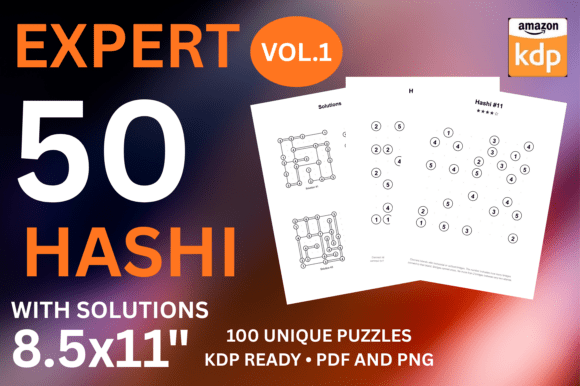
This isn’t just another activity book filler. The puzzles here are algorithmically tested for zero duplicates and flawless logic, meaning every single grid holds up under scrutiny. For anyone building a brand around brain teasers, educational content, or premium print-on-demand products, this interior represents a serious asset. The clean 8.5 x 11 inch layout with no bleed makes it ready to upload to platforms like Amazon KDP, IngramSpark, or Gumroad without last-minute formatting headaches.
What Sets This Puzzle Collection Apart
Hashi puzzles work on a beautifully simple premise: you connect islands with bridges, following rules about connection counts, directionality, and crossing restrictions. But simplicity is deceptive. At the expert level, these grids demand genuine strategic thinking — the kind that keeps solvers engaged for twenty minutes or more per puzzle. Expert Hashi Bridges Puzzles Vol 1 includes 50 unique puzzles with full solutions, each one crafted so that the logic chain flows naturally from first bridge to last.
The visual personality of this collection is what immediately caught my attention. Every grid is presented as a high-resolution individual PNG image, which means you can drop these directly into your layout software without worrying about scaling artifacts or resolution loss. The typography on each island number is clean and unambiguous — a small detail that matters enormously when a solver is trying to distinguish between a 3 and an 8 at a glance. The bridge lines are thick enough to print clearly on standard home printers yet refined enough to look professional in a commercial offset run.
As a publisher or content creator, you’re probably juggling multiple product lines. Having a ready-to-upload asset like this means you can go from concept to listing in under an hour. No need to hire a puzzle constructor, test for duplicate puzzles, or wrestle with formatting inconsistencies. The interior has been optimized for both high-quality printing and digital use, so whether your customers prefer a paperback they can scribble in with a pencil or a PDF they solve on a tablet, the experience remains smooth.
Where This Puzzle Interior Works Best
I’ve seen puzzle books take many forms over the years — spiral-bound desk calendars, travel-sized brain teaser collections, large-print editions for seniors, even digital subscriptions delivered weekly via email. Expert Hashi Bridges Puzzles Vol 1 adapts well to all these formats, but a few use cases stand out.
Print-on-demand puzzle books are the obvious starting point. The 8.5 x 11 inch trim size is a standard that fits comfortably in a backpack or on a coffee table, and the no-bleed requirement simplifies upload dramatically. You can pair this interior with a professional cover design and have a product live in a matter of hours.
Digital marketplaces like Etsy or Creative Market are another strong fit. Individual puzzle packs, printable PDFs, or even low-content books featuring these grids attract buyers looking for screen-free entertainment. The high-resolution PNG format means you can also create sample pages for marketing without losing quality.
Educational and therapy contexts often get overlooked in puzzle publishing conversations. Yet occupational therapists, math teachers, and cognitive training coaches regularly seek logic puzzles that challenge without frustrating. Because these puzzles are algorithmically verified for sound logic, they never hit a dead end due to a constructor error — a crucial reliability factor for professional use.
Gift and leisure markets also benefit. A well-designed puzzle book makes a thoughtful present for travelers, retirees, or anyone who enjoys quiet mental stimulation. The expert difficulty level appeals to solvers who have already mastered the basics and crave a deeper challenge.
How Puzzle Quality Shapes Brand Perception
When you publish a puzzle book, you’re not just selling entertainment — you’re selling trust. Every time a solver picks up your book, they’re placing confidence in your product’s accuracy and fairness. A single unsolvable puzzle or duplicated grid can damage that trust significantly. This is where the algorithmic testing behind Expert Hashi Bridges Puzzles Vol 1 becomes a genuine business advantage.
The puzzles are engineered with mathematical precision. Each island’s number corresponds exactly to the bridges that can connect to it, and the overall network forms a single continuous path — one of the core rules of Hashi. Solvers who have encountered poorly constructed puzzles elsewhere will immediately notice the difference. The logic flows cleanly, the constraints are fair, and the solutions reward careful reasoning rather than guesswork.
From a brand identity perspective, consistency matters enormously. If you publish multiple puzzle volumes — say a Hashi book, a Sudoku collection, and a crossword anthology — your audience comes to expect a certain standard. Including an interior that meets professional construction standards raises the bar for your entire catalog. It signals that you take quality seriously, which encourages repeat purchases and word-of-mouth referrals.
For small business owners and entrepreneurs specifically, this kind of attention to detail can be the difference between a product that sells steadily and one that gets returned. Puzzle buyers are a loyal audience, but they’re also discerning. They notice when a book feels slapped together. A polished interior with zero logical errors helps you compete with larger publishers who have dedicated editorial teams.
Practical Guidance for Integrating This Asset
If you’re considering adding Expert Hashi Bridges Puzzles Vol 1 to your product lineup, here are a few practical steps to evaluate fit and maximize its potential.
Assess your audience’s skill level. While these are classified as expert puzzles, that doesn’t mean only seasoned solvers can enjoy them. Experienced Hashi players will appreciate the challenge, but beginners might benefit from a companion volume with easier puzzles or a rule page at the front. Consider including a brief how-to-play section — the four rules listed in the technical specs are concise and easy to adapt into your own wording.
Think about format variety. The individual PNG files give you flexibility. You could create a standard paperback, but you could also produce a large-print edition for visually impaired solvers, a spiral-bound version for easy page-flattening, or a digital bundle that includes answer sheets separately. Each format opens a different customer segment.
Pair with complementary content. Puzzle books don’t have to stand alone. You could wrap this interior into a larger compilation that includes word searches, logic grids, or even space for solvers to log their completion times. Subscription boxes, monthly puzzle clubs, and membership sites all benefit from having a reliable puzzle source they can draw from repeatedly.
Consider licensing and usage rights. The commercial licensing included with this asset typically allows you to incorporate the puzzles into products you sell. Always review the specific license terms, but in general, ready-to-upload interiors like this are designed for exactly that purpose. You’re not renting the puzzles — you’re acquiring a component you can productize.
Test your own workflow. Before listing, order a physical proof or download a sample and run it through your usual software. Check that the PNG files import cleanly into whatever layout tool you use — Canva, Affinity Publisher, Adobe InDesign, or even Word. Verify that the no-bleed specification aligns with your printer’s requirements. A quick dry run prevents last-minute surprises.
The Real-World Value of a Professionally Constructed Puzzle Interior
I’ve worked with puzzle books that were assembled with care and with others that clearly had never been touched by human eyes after algorithmic generation. The difference is palpable. Expert Hashi Bridges Puzzles Vol 1 falls into the first category. The zero-duplicate guarantee and faultless logic testing aren’t marketing fluff — they’re features that directly affect your bottom line.
Fewer customer complaints, fewer returns, stronger reviews, and a catalog that feels cohesive and reliable. For designers and content creators juggling multiple projects, having a puzzle asset that’s genuinely ready to publish saves hours of back-and-forth editing. For entrepreneurs and small business owners, it means you can focus your energy on marketing and customer engagement rather than puzzle construction.
Ultimately, the best puzzle books disappear into the solver’s hands. They don’t call attention to formatting glitches or questionable logic. They just work. That invisible reliability is what builds long-term audience trust. And in a market saturated with generic puzzle compilations, trust is the asset that keeps your products selling month after month.
Whether you’re launching your first puzzle book or expanding an established portfolio, this interior offers a solid foundation. The bridges are laid — you just need to connect them to the right audience.